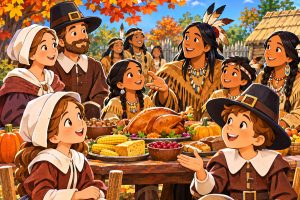
The First Thanksgiving Feast is a children’s play inspired by the historic harvest celebration of 1621 in Plymouth, Massachusetts. After a difficult first year, the English settlers celebrated their successful harvest, an event attended by members of the Wampanoag community.
Through the story of Mary and George, children discover how the settlers received help from their Native American neighbors, who shared their knowledge of planting, hunting, and fishing. As both communities gather for a special feast, they learn the importance of gratitude, generosity, cooperation, and sharing.
This heartwarming Thanksgiving play reminds us that we have many reasons to be thankful and that kindness and understanding can bring people together.
CHARACTERS:
- NARRATOR (Can be one older child or split between two)
- MARY – Pilgrim girl
- GEORGE – Pilgrim boy
- MOTHER
- FATHER
- TISQUANTUM (SQUANTO) – Wampanoag friend
- PILGRIMS – Ensemble (Women, men, children)
- WAMPANOAG VILLAGERS – Ensemble (Women, men, children)
SCRIPT:
SCENE 1: THE AUTUMN FOREST
(The stage is set with paper autumn leaves on the floor. MARY and GEORGE enter wearing Pilgrim hats and bonnets. They are carrying a large woven basket, pretending to pick berries and nuts off the ground.)
NARRATOR: It is the autumn of 1621. After a very hard winter, the Pilgrims are finally ready to celebrate their first big harvest.
GEORGE: (Wiping his forehead) Phew! Look at all these cranberries and walnuts, Mary. My hands are turning purple!
MARY: (Shivering and rubbing her arms) Brrr! The autumn wind is chilly today. And this basket is getting way too heavy for me!
GEORGE: Here, let’s carry it together. One, two, three—lift!
(They each grab one handle and carry the basket together.)
MARY: Mother and Father are going to be so proud!
GEORGE: (Pointing offstage) Look! There they are by the edge of the woods!
(MOTHER and FATHER enter. FATHER is carrying a large cloth-wrapped bundle. MARY and GEORGE hurry over to them.)
MARY: Mother! Father! Look at all the berries and nuts we gathered!
MOTHER: (Smiling and peeking into the basket) Wonderful work, children! You filled it to the very top.
GEORGE: (Sniffing the air) Mmm, what smells so good in your bundle, Father?
FATHER: Freshly baked cornbread! Now come along, everyone is waiting for us in the village. We mustn’t be late for the feast!
MARY AND GEORGE: (Excitedly) Let’s go!
SCENE 2: THE VILLAGE OF PLYMOUTH
(The family walks across the stage. PILGRIMS are bustling around a long table, setting down wooden plates, cups, pumpkins, and corn. Autumn music can play softly in the background.)
NARRATOR: Back in Plymouth, the whole village is busy preparing for a three-day celebration.
MARY: (Looking around in amazement) Oh, look at the table! There is so much food!
GEORGE: Pumpkins, squash, cornbread, and roasted duck! My stomach is already growling. (Rubs his belly)
MARY: Mother, why are we having such a giant party today?
MOTHER: Because today is a day of thanksgiving, Mary. Last winter was cold and scary, and we didn’t have enough food.
FATHER: But we survived! Today, we thank God for our new homes, our health, and this wonderful harvest.
MOTHER: Now, children, place your basket right in the center of the table. And Mary, please gather some wildflowers to make the table look bright.
(MARY and GEORGE place the basket down. MARY skips to the side of the stage to pick a bunch of colorful flowers.)
(Suddenly, rhythmic drumbeats sound from offstage. TISQUANTUM and the WAMPANOAG VILLAGERS enter, wearing traditional woven mantles, deerskin clothing, and colorful beaded necklaces. They are carrying baskets of food and a large platter.)
MARY: (Running back to her parents, surprised) Mother! Father! Who are those people?
FATHER: (Smiling warmly) Do not be afraid, Mary. Those are our Wampanoag neighbors. They are our friends.
MOTHER: They have lived on this land for thousands of years. Without their help, we would not have survived the winter.
GEORGE: How did they help us?
FATHER: Tisquantum taught us how to plant corn using fish to help the soil grow, and where to find the best places to hunt and fish.
MARY: (Admiringly) Look at their beautiful beaded necklaces and deerskin clothes!
TISQUANTUM: (Stepping forward with a warm smile) Greetings, my friends! We heard the sounds of celebration and came to join you.
WAMPANOAG VILLAGERS: (Together) We brought food to share!
(Tisquantum holds up a large platter with a roasted turkey, while the villagers hold up baskets of corn and deer meat.)
GEORGE: (Eyes wide) Whoa! Look at the size of that turkey!
MOTHER: Welcome, friends! Please, put your food on the table and join us. It is time to eat!
SCENE 3: THE FEAST
(Everyone gathers around the long table, standing behind their chairs or sitting together.)
NARRATOR: Pilgrims and Wampanoag sat side by side, sharing stories, playing games, and enjoying a meal together.
FATHER: Heavenly Father, thank You for blessing our harvest and watching over us.
MOTHER: We are thankful for our families, our health, and the kindness of our new friends.
TISQUANTUM: And we are thankful for peace, good neighbors, and the gifts of the earth.
EVERYBODY: (Raising their cups together) Happy Thanksgiving!
(Everyone steps forward in a semi-circle facing the audience, smiling brightly. Upbeat acoustic music begins)
NARRATOR: Now, everyone join in and sing!
ALL CAST: (Singing to the tune of “Twinkle, Twinkle, Little Star”)
Thank you for the autumn breeze, (Sway arms like wind) Thank you for the golden trees! (Reach arms up like branches) Thank you for the food we share, (Pretend to hold a plate) Thank you for the friends right here! (Point to neighbors on left and right) Hands together, big and small, (Clasp hands together) Happy Thanksgiving to you all! (Wave enthusiastically to the audience)
(Everyone takes a big bow together as the audience applauds and the curtain closes.)
THE END
AUTHOR: K I D S I N C O
Conclusion: The First Thanksgiving Feast reminds us that gratitude is about more than celebrating a good harvest. It is also about recognizing the kindness of others, appreciating what we have, and sharing our blessings.
Mary, George, and their families discover that working together and helping one another can make difficult times easier. Their celebration teaches us that friendship, generosity, and respect are important values that bring communities closer together.
Just as the characters share their food and happiness, we can also make every day special by being thankful and helping those around us.
Moral of the Story: Gratitude, kindness, and cooperation make life better. We should appreciate the help we receive, respect others, and share our blessings with those around us.
Moral Values:
- Gratitude: Being thankful for the food, family, and blessings we have.
- Generosity: Sharing what we have with others.
- Cooperation: Working together to overcome difficulties.
- Friendship: Building positive relationships with others.
- Kindness: Helping people who need support.
- Respect: Appreciating different cultures, traditions, and ways of life.
- Community: Understanding that people can achieve more when they help one another.
- Appreciation: Recognizing the importance of nature and its gifts.
👉 Another Kidsinco Thanksgiving Story to Enjoy :
👉 Explore our full collection of free play scripts for kids, perfect for classroom performances.
👉 External Resources:
- National Museum of the American Indian – Rethinking Thanksgiving Celebrations
- Plimoth Patuxet Museums – Thanksgiving
- First Thanksgiving – National Geographic Kids
- National Archives – Thanksgiving: Historical Perspectives
This play script, “The First Thanksgiving Feast,” is the property of Kidsinco and may not be republished, copied, or distributed on any other website, blog, forum, or social media platform without written permission from Kidsinco. It is intended for personal and educational use only.
Thank you for visiting Kidsinco Free Play Scripts for Kids!