
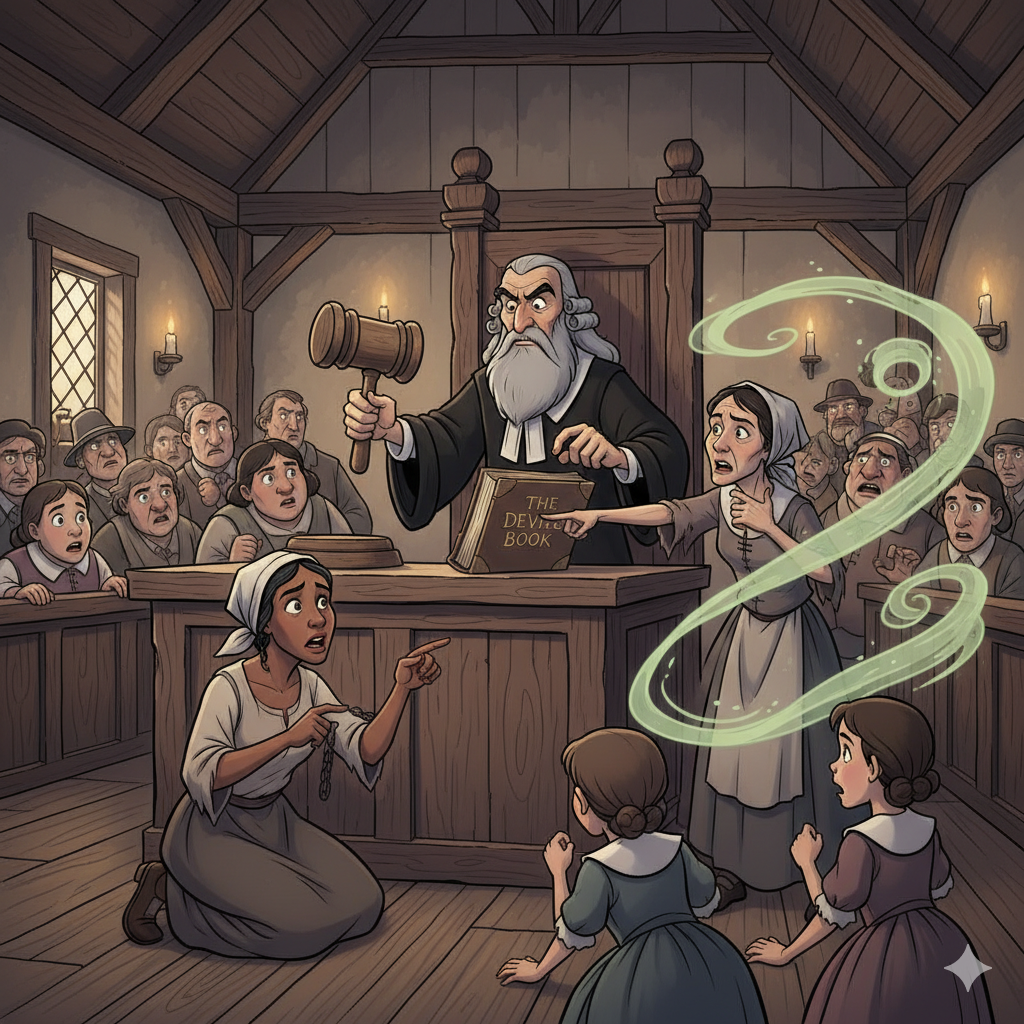
“The Salem Hysteria: A Shadow Over Justice” is a dramatic retelling inspired by the tragic events of the Salem Witch Trials of 1692. In this play, we witness how fear spreads like wildfire, how innocent people become victims of lies, and how justice can crumble when truth is silenced by hysteria. Through the voices of Samantha, Rebecca, Tituba, Sarah Good, and Judge Hathorne, we explore how suspicion turns neighbor against neighbor, and how the desperate need for safety can destroy the very soul of a community.
This story reminds us that truth must never be sacrificed for fear, and that courage in the face of injustice is the truest form of bravery.
CHARACTERS:
NARRATOR
SAMANTHA – A young girl, initially skeptical but easily swayed by fear.
REBECCA – Samantha’s friend, already consumed by the hysteria.
JUDGE HATHORNE
TITUBA – A slave from Barbados, exhausted and beaten down.
SARAH GOOD – A poor, exhausted woman.
ABIGAIL – One of the main accusers, acting out her ‘affliction
Scene 1: The Seed of Fear
(Setting: A cobblestone street in Salem Village. The air is tense. It is early March 1692. A chill is in the air.)
NARRATOR: The year is 1692. A shadow has fallen over Salem Village, Massachusetts. Whispers have become shouts, and doubt has curdled into terror. Girls are suffering from fits they claim are caused by Witchcraft. The first accused has been arrested, and the village holds its breath, ready to condemn.
(Samantha hurries onto the stage, pulling her cloak tight. Rebecca approaches her, eyes wide with feverish excitement.)
SAMANTHA: Rebecca! You look dreadful. Did you sleep at all last night?
REBECCA: (Grabbing Samantha’s arm, voice low and frantic) Sleep? How can anyone sleep? The devil walks among us! My little sister, Betty… she had another fit. Spitting, screaming names no child should know.
SAMANTHA: Nonsense! It’s the illness everyone talks about. Tituba’s stories have just given the illness a name—a wicked name.
REBECCA: (Pulling back, offended) Don’t you dare! You sound like a skeptic! You sound like you doubt the afflicted! Abigail Williams has seen the specters—clear as day! They pinch her, they choke her! Who would do such a hateful thing? Only servants of the dark master!
SAMANTHA: (Her bravado faltering) But… Tituba is just a slave. And Sarah Good is just poor, a beggar. Is that enough to hang someone?
REBECCA: (Eyes narrowing, a dangerous edge to her voice) Sometimes, Samantha, a person just has to look poor and friendless to hide a wicked heart. Be careful who you defend. The devil is tricky.
(Rebecca glares, then hurries off. Samantha shivers, looking after her.)
Scene 2: The Interrogation
(Setting: The Courtroom. Judge Hathorne sits at a high bench, stern and unforgiving. The atmosphere is cramped and suffocating. Tituba and Sarah Good are brought forward, chained, looking terrified and defeated, and placed before the bench.)
JUDGE HATHORNE: (Banging a gavel, his voice booming) Order in this court! We are here to seek the truth, and to purge this community of the corruption that festers in its soul! Tituba, you are the first to be questioned. Look upon the girls! Do you deny you’ve signed the Devil’s book?
TITUBA: (Whispering, head bowed) Sir, I know nothing of such a book. I am from Barbados. I know no English devil.
JUDGE HATHORNE: (Leaning forward, menacingly) Yet your spirit torments the girls! Look at Abigail!
(ABIGAIL rushes in, dramatically clutching her throat and gasping for breath. She points a shaking, accusatory finger at Tituba.)
ABIGAIL: (Screaming) She chokes me! Her specter is here, Judge! It presses its icy hand upon my windpipe! Tell the truth, you wicked woman!
TITUBA: (Terrified, looking from the screaming girl to the cold judge.) No! It is not my spirit!
JUDGE HATHORNE: Speak, woman! Confess! The only mercy you will find is in the truth!
TITUBA: (She collapses on the ground, overwhelmed by the pressure, fear, and pain. Her voice is ragged.) Yes… Yes, I confess! I have seen the black dog! A tall man, he made me sign! He told me to hurt the children! But… but Sarah Good was with me! She signed, too! And Sarah Osborne!
(A gasp goes through the unseen crowd. Judge Hathorne looks satisfied.)
JUDGE HATHORNE: (To Sarah Good, triumphantly) You hear her! Tituba has named you! How do you plead?
SARAH GOOD: (Standing tall, despite her chains, her voice shaking with righteous fury) I curse her lie! I am innocent! I have made no pact! If I am to die, then you will all be held accountable for the blood of an innocent woman! I am no witch, but I fear God’s justice far more than yours, sir!
JUDGE HATHORNE: Silence! The book is open! The Devil is unmasked!
(He slams the gavel down. The sound echoes loudly.)
Scene 3: The Dark Chapter
(Setting: The cobblestone street in Salem Village, later. Samantha enters, distraught.)
NARRATOR: Tituba’s confession broke the dam. The fear became a flood. To confess was to live, to deny was to die. Soon, twenty innocent lives were taken in the name of God and law.
SAMANTHA: (Alone, whispering to herself) They hanged her. They hanged Sarah Good. She cursed them all, all the judges, as they pulled the rope. Rebecca was there, cheering. Oh, Mother, what have we become?
(Samantha sinks to her knees, weeping.)
NARRATOR: What happened in Salem was not a lesson in finding witches; it was a devastating lesson in the fragility of justice. Fear, once given authority, will devour reason. The Salem Witch Trials stand as a stark, tragic reminder: The most dangerous spirit is not the Devil’s, but the human impulse to sacrifice truth for the sake of certainty.
(Samantha slowly rises and walks off, looking back at the invisible court with profound grief.)
The flames of hysteria that once consumed Salem may have burned out, but their ashes still whisper a warning through time. “The Salem Hysteria: A Shadow Over Justice” shows how easily justice can be blinded when emotion replaces reason. As Samantha’s sorrow echoes through the centuries, we are called to remember that truth and compassion are the strongest shields against fear. Let Salem’s story not only haunt us—but teach us—to seek understanding before judgment, and to defend fairness even when it is hardest to do so.
The End
Author: K I D S I N C O, based on historical accounts of the Salem Witch Trials of 1692.
Moral of the Story: Fear, when left unchecked, can destroy truth and justice. Only courage, compassion, and reason can protect us from repeating the mistakes of the past.
Moral Values:
- Justice: True justice is based on evidence and fairness, not emotion or fear.
- Courage: It takes bravery to speak the truth when everyone else is silent.
- Compassion: Understanding others can prevent cruelty born from ignorance.
- Integrity: Standing firm in what is right, even when it is unpopular, defines one’s character.
- Awareness: Questioning what we hear and think critically protects us from manipulation.
👉 Explore our full collection of free play scripts for kids, perfect for classroom performances
👉 External Resources:
- Salem Witch Museum – Explore detailed timelines, personal stories, and background on the Salem Witch Trials.
- Salem Witch Trials – A simplified explanation for young readers about the events in 1692.
The Origins of the Salem Witch Trials (1692)
In the winter of 1692 in Salem Village, Massachusetts, a fear unlike any before gripped the Puritan community. It began when a group of young women, including the slave Tituba, started suffering strange fits, claiming they were being tormented by invisible spirits—an act they blamed on local witches. As town leaders and magistrates became convinced that the Devil was actively recruiting members in their midst, the resulting panic led to the arrest and interrogation of over 200 people. Testimony based on dreams and visions, known as spectral evidence, was accepted as truth. This hysteria ultimately shattered the rule of law, leading to mass trials and the tragic execution of twenty innocent individuals before the madness finally subsided. The events remain a stark reminder of how fear can easily turn neighbors into accusers and destroy a community’s sense of justice.
This play script, “The Salem Hysteria: A Shadow Over Justice,” is the property of Kidsinco and may not be republished, copied, or distributed on any other website, blog, forum, or social media platform without written permission from Kidsinco. It is intended for personal and educational use only.
Thank you for visiting Kidsinco Free Play Scripts for Kids!