
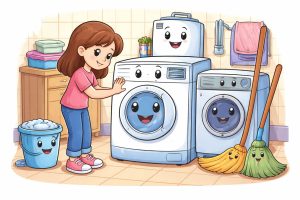
Welcome to The Kindness That Fixed The Washing Machine, a heartwarming and imaginative play where everyday household objects come to life. In this story, we step into a simple laundry room where something extraordinary happens—feelings, words, and actions begin to matter more than we ever thought possible.
Through Erika’s journey, we discover how the way we treat others—even the things around us—can have a powerful impact. This charming tale reminds us that kindness, gratitude, and respect can transform not only our relationships but also our world.
CHARACTERS:
ERIKA
WASHING MACHINE
DRYER MACHINE
WATER HEATER
BROOM
MOP
WATER BUCKET
CARMEN (ERIKA’S SISTER)
SCRIPT:
Act 1 – In The Laundry Room
(The Washing Machine, Dryer Machine, and Water Heater are center stage. Nearby are the Broom, Mop, and Water Bucket. Erika enters carrying a laundry basket full of clothes. She sets it down and begins loading the Washing Machine.)
ERIKA: Ugh, I hate doing laundry! I could be on Facebook right now… but no, I have to wash clothes!
(The Washing Machine door accidentally closes and hits Erika’s hand.)
ERIKA: Ouch! Stupid washing machine!
(She kicks it lightly and finishes loading it.)
I hope you don’t spill water again. I don’t feel like mopping today!
(She presses the ON button and exits.)
WATER HEATER: Don’t be sad. She’ll calm down soon.
WASHING MACHINE: (crying) It’s always the same… She insults me, yells at me, and even kicks me.
(Water begins to leak.)
WATER HEATER: I know… I don’t like how she treats you either.
MOP: Me neither.
WATER BUCKET: It’s a shame we can’t protect you.
DRYER MACHINE: Sometimes I feel like burning all her clothes!
BROOM: Don’t do that, or she’ll treat you even worse!
WATER HEATER: (looking down) Oh no… you’re leaking again. Please stop.
WASHING MACHINE: Let my tears flow…
MOP: No! I’ll clean it up. I don’t want her to come back and yell at you again.
(Mop cleans the floor.)
WATER BUCKET: Remember, she warned you not to spill water.
WASHING MACHINE: I’m not a good washing machine…
DRYER MACHINE: Don’t say that!
WATER HEATER: We love you just the way you are.
BROOM, MOP, WATER BUCKET: Yes, we do!
WASHING MACHINE: But I’m falling apart… My door hit her. I’m useless.
(Erika enters.)
ERIKA: You’re still not done?! (She notices the wet floor.) Did you spill water again? (She grabs the mop and cleans angrily.) Now you’re not even working! Nobody wants you—you’re just junk! I should buy a new washing machine. I’ll ask Carmen to come with me.
(She exits.)
WASHING MACHINE: She’s going to replace me…
DRYER MACHINE: We’ve been together for so long. I can’t lose you.
WASHING MACHINE: No… I’m the problem.
MOP: We’ll miss you.
WATER BUCKET & BROOM: We will too.
WATER HEATER: Don’t say that! She’s not going anywhere. (to Washing Machine) Stay strong—for all of us.
DRYER MACHINE: Yes, for all of us!
WASHING MACHINE: (sadly) Please don’t argue… I’m not worth it.
WATER HEATER: You mean everything to us.
WASHING MACHINE: I’m sorry… truly sorry.
Act 2 – In The Living Room
(Carmen is sitting on the sofa with her phone. Erika enters.)
ERIKA: Are you busy?
CARMEN: No, why?
ERIKA: Come with me to buy a new washing machine. Ours is useless.
CARMEN: That’s strange. I just used it today—it worked perfectly.
ERIKA: Well, it’s not working now, and there’s water everywhere. I’m tired of cleaning!
CARMEN: I don’t believe it spills water.
ERIKA: Well… it does when I use it.
CARMEN: I’m going to tell you something, but don’t laugh.
ERIKA: What?
CARMEN: Talk to the washing machine.
ERIKA: What?! Do you think I’m crazy?
CARMEN: No. But everything responds to how it’s treated. And I’ve seen how you treat it.
ERIKA: I’ll just waste my time!
CARMEN: Or maybe you’ll fix the problem.
ERIKA: I don’t believe in “positive energy” and all that.
CARMEN: Maybe it’s not about energy… maybe it’s about kindness.
ERIKA: Fine… you win. What do I say?
CARMEN: Say the opposite of what you usually say—but mean it.
ERIKA: I’ll try.
CARMEN: (kissing her cheek) Thank you.
ERIKA: If the neighbors see me, they’ll think I’m crazy! Let’s go.
Act 3 – In The Laundry Room
(Erika and Carmen stand in front of the Washing Machine.)
ERIKA: I don’t even know how to begin… (She places her hand gently on the machine.) Washing Machine… thank you. You’ve helped me more than I ever realized. I know I’ve overloaded you… and made you work too hard. But I chose you because you were the best—and you still are. I’m sorry for yelling at you, kicking you, and blaming you. It’s not your fault when I’m in a bad mood.
(The machine turns on and begins working.)
ERIKA: Wait… what?!
CARMEN: It’s working!
ERIKA: I don’t know if it’s a coincidence… but I do know one thing—I’ll never treat you badly again.
CARMEN: And now, you’ve made it happy too.
ERIKA: Let’s celebrate. Dinner’s on me!
CARMEN: Now that sounds perfect!
(They exit.)
WATER HEATER: That was incredible!
BROOM: Not a miracle—just kindness.
MOP & WATER BUCKET: Hooray! She’s staying!
DRYER MACHINE: I thought I lost you forever!
WATER HEATER: How do you feel?
WASHING MACHINE: Happy… truly happy. Now I know I’m appreciated.
ALL: Hooray!
(They gather around and hug the Washing Machine.)
THE END
Author: K I D S I N C O
Conclusion: The Kindness That Fixed The Washing Machine reminds us that our words and actions carry more power than we imagine. Through Erika’s transformation, we see how a simple change in attitude can repair not only machines—but also relationships and hearts. Kindness doesn’t cost anything, yet it can fix everything.
Moral of the Story: Treat everything—and everyone—with kindness and respect, because your attitude can make all the difference.
Moral Values:
- Kindness
- Respect
- Gratitude
- Empathy
- Responsibility
- Positive Attitude
👉 Explore our full collection of free play scripts for kids, perfect for classroom performances.
👉 External Resources:
- Random Acts of Kindness Foundation – Ideas and lesson plans to encourage kindness in daily life.
- The Importance of Teaching Moral Values for Kids: Tips and Benefits – Kidzee
This play script, “The Kindness That Fixed The Washing Machine,” is the property of Kidsinco and may not be republished, copied, or distributed on any other website, blog, forum, or social media platform without written permission from Kidsinco. It is intended for personal and educational use only.
Thank you for visiting Kidsinco Free Play Scripts for Kids!