
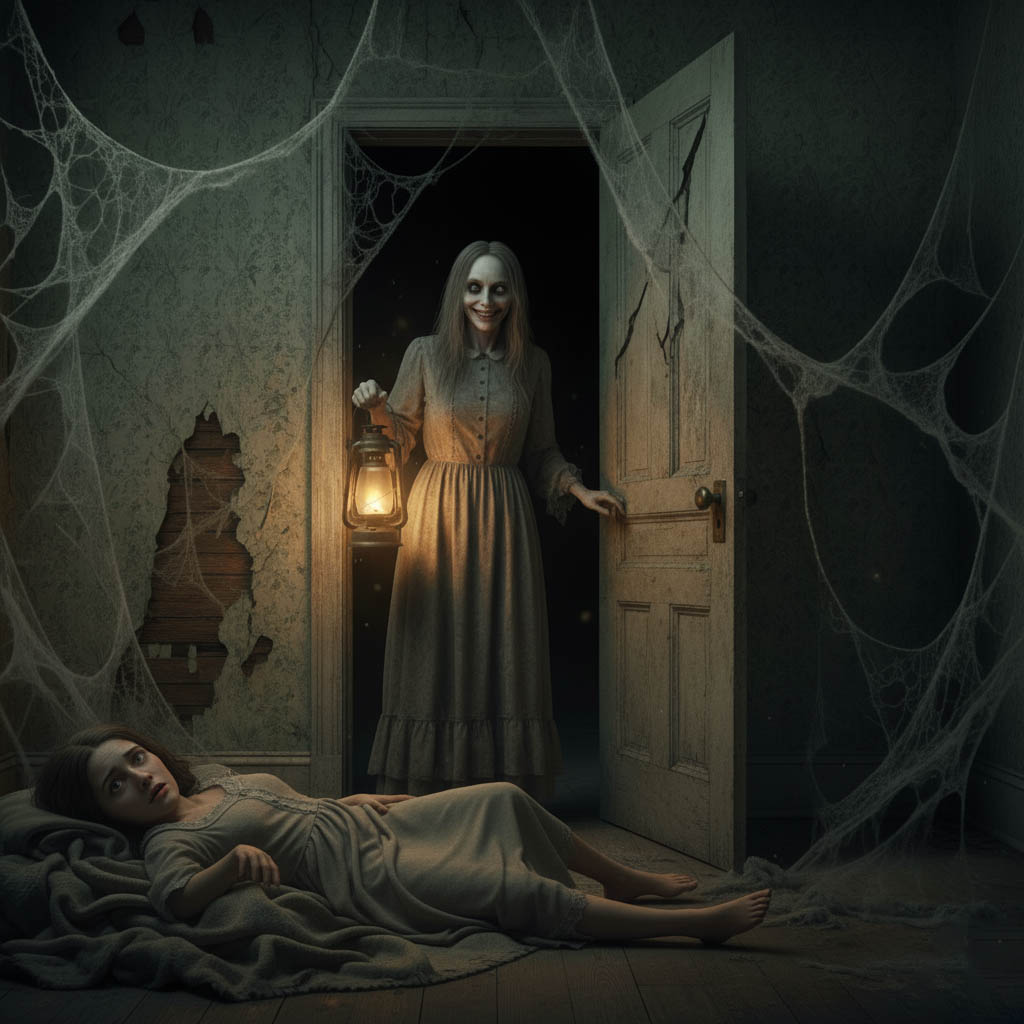
In “The Echo in the Walls”, we enter the fragile world of Dianne, a young girl haunted by something she cannot name — a presence that lives within silence itself. Trapped between dreams and waking, she struggles to escape the echoing chambers of her mind, where fear takes shape and truth hides in the dark corners of her home. This chilling psychological tale explores how grief, repression, and loneliness can twist into something far more terrifying than any monster under the bed.
CHARACTERS:
DIANNE: A teenager, perpetually exhausted.
MOTHER (SARAH): Caring, but increasingly weary and detached.
THE SILENCE (VOICE OF MONSTER): A dry, whispering, sibilant voice. It never laughs, only sucks the sound out of the air.
SCRIPT:
Setting: Dianne’s bedroom. Minimalist, with a large, ornate mirror (or portrait) positioned so that it only reflects the dark corner of the room when the stage lights are low. Heavy, dusty curtains cover the window.
ACT I
(The stage is bathed in a sickly, pale moonlight that filters through the heavy curtains. Dianne lies in her bed, tangled in the sheets. Her breath is ragged. She is not thrashing, but twitching in micro-movements, as if being held down by an invisible weight. A low, rhythmic thump… thump… can be heard.)
DIANNE: (A strained, dry whisper) No. Don’t touch… the glass.
THE SILENCE: (A dry, rustling sound, like insects walking on parchment, close to the mic): You know the rule, Dianne. I never touch you. Only the things you love.
DIANNE: Please, why is the hall always growing longer? I can’t find the door.
THE SILENCE: It’s a mirror, my dear. Not a door. (The thump… thump… quickens slightly.) You’re running backward.
DIANNE: Stop the noise! Make it stop!
THE SILENCE: I can’t. That’s your heart, Dianne. And it’s running out of rhythm.
(The bedroom door cracks open, letting a sliver of hallway light spill across the floor. Mother (Sarah) stands there, looking drained. She steps to the bed and places a weary hand on Dianne’s shoulder.)
MOTHER: Dianne. Dianne! Wake up. You’re home.
(Dianne’s eyes snap open. She gasps, a sharp, choked sound, and shrinks away from her Mother’s touch.)
DIANNE: Don’t! Don’t look at me!
MOTHER: (Softly, pulling her close): It’s me, sweetheart. Just Mother. It was a bad dream. Again.
(Dianne clings to her, trembling, the panic subsiding into a desperate exhaustion.)
DIANNE: It’s not a dream anymore, Mother. It’s a visit. Every night. It’s the same… house, the same hallway. But last night… it knew my name. It said… it lives in the silence.
MOTHER: (Stroking Dianne’s hair, her eyes drifting toward the dark mirror/portrait) You need to let it go, dear. You worry about too many things. Too much school. Too much stress.
DIANNE: What if the dream… isn’t coming from me? What if it’s coming for me?
MOTHER: (Standing up, avoiding her gaze) I’ll get you a glass of water.
DIANNE: No, Mother, stay. Please. If I close my eyes alone… it’ll think I invited it back.
MOTHER: I can’t just sit here every night, Dianne. I have to work tomorrow. You need to fight this on your own. You’re not a child.
(Mother turns to leave, but stops at the door. Her expression is complex—pity mixed with an old, deep fear.)
MOTHER: I’ll leave the hall light on. Just try to breathe.
(Mother exits. The small sliver of light vanishes. The subsonic hum returns, louder now. Dianne struggles to keep her eyes open, staring at the ceiling. The rhythmic thump… thump… is back.)
DIANNE: I am awake. I am in my room. It’s just a room.
(The sound of a door slamming far away makes her jump. She clenches her eyes shut, then opens them immediately. She cannot sleep. The silence in the room is crushing.)
THE SILENCE: (Closer now, like the voice is inside her pillow) See? She leaves you.
DIANNE: You’re not real. I’m awake.
THE SILENCE: You always say that. And you’re always wrong. (A slight pause. The thump… thump… changes; it now sounds like the slow scraping of a single fingernail on wood.) I was wondering, Dianne… in the dream, why are you always running to the locked door? Why not the window?
DIANNE: Because…because outside the window… there’s nothing. Just black sky. No ground.
THE SILENCE: Exactly. Nowhere to go. That’s why I’m so comfortable here.
DIANNE: What do you want? Why are you repeating this night?
THE SILENCE: I don’t repeat the night, Dianne. I repeat what you bury. (The voice is now coming from the dark corner reflected in the mirror.) I’m not a monster chasing you. I’m the part of you that stopped running.
(Dianne slowly sits up in bed, staring at the dark mirror. The faint reflection of the corner is impossibly dark.)
DIANNE: That’s a lie. I’m terrified of you.
THE SILENCE: You’re terrified of what I represent. You were so tired of running from your fears, from the noise, from the silence of this house… so you built the hall in your head, and I agreed to guard the end of it.
(A slow, grating sound begins. Dianne realizes it’s the sound of the bedroom door unlocking, from the outside. She holds her breath.)
THE SILENCE: Your Mother is coming back. Tell her about the house.
DIANNE: No. She wouldn’t understand.
THE SILENCE: Oh, she understands, Dianne. Ask her where she goes when she leaves your room. Ask her what’s behind the portrait in the dining room.
(The bedroom door begins to creak open very slowly. Dianne freezes, staring at it. The movement is agonizingly slow. The person opening the door is barely visible.)
DIANNE: What are you doing?
THE SILENCE: Making the dream real, Dianne. Isn’t that what you wanted? A visitor?
(Mother steps into the room. She is completely silent. Her face is pale and blank. In her hand, she carries a flickering, old-fashioned oil lamp. The light she casts is sickly yellow. She doesn’t look at Dianne, but slowly walks to the dark mirror/portrait.)
DIANNE: Mother? What are you doing?
(Mother reaches out a hand to the mirror. Slowly, her fingers begin to smudge the dust on the glass. The thump… thump… returns, emanating from the Mother’s chest.)
DIANNE: (Crying) Mother, stop! Don’t touch the glass!
(Mother lifts her head and slowly turns to face Dianne. Her eyes are wide, black, and unblinking. The voice does not come from her, but the air around her.)
THE SILENCE: See, Dianne? She’s not running anymore, either.
(Mother smiles—a slow, vacant, unnatural smile. She lifts the oil lamp, illuminating the room completely for the first time. The room is NOT Dianne’s room. It is a derelict space: cracked wallpaper, cobwebs, and a single, rotting, locked door in the center of the back wall. Dianne is not in a bed, but lying on a pile of dusty blankets on the floor.)
DIANNE: (Screaming, but no sound comes out.)
(Mother walks toward the locked door, holding the lamp high. She places her other hand on the doorknob. The moment she touches it, the thump… thump… stops entirely. The Silence is absolute.)
THE SILENCE: Good night, Dianne. You’re finally where you belong.
(Mother twists the knob. A deafening, metallic CLICK echoes. She pushes the door inward. Total darkness engulfs the stage as the oil lamp is plunged into the open doorway. The only sound is the quick, shallow breathing of Dianne.)
The Echo in the Walls leaves us with a lingering question: what happens when the silence inside us becomes louder than the world outside? Dianne’s descent reminds us that the monsters we fear most often come from within — born from secrets unspoken and emotions buried too deep. When fear is ignored, it grows stronger until even our reflection becomes a stranger. Only by facing the echoes of our own pain can we finally find peace in the quiet.
The End
Author: K I D S I N C O
Moral of the Story: Silence can hide the deepest fears, but only by facing what lives within us can we find peace and light again.
Moral Values:
- Courage: True bravery means confronting the darkness inside ourselves, not running from it.
- Self-awareness: Understanding our fears helps us heal and grow stronger.
- Empathy: Listening and caring for others can break the silence of loneliness.
- Communication: Sharing our pain brings comfort and connection.
- Emotional honesty: Pretending everything is fine only feeds the shadows we try to escape.
👉 Explore our full collection of free play scripts for kids, perfect for classroom performances
👉 External Resources:
How to Help Children Manage Fears – Child Mind Institute
Fears & Phobias in Children: How Parents Can Help – HealthyChildren.org
Symbolism: Mirrors and Symbolism: Reflecting on Deeper Meanings – Faster Capital
ABOUT THE PLAY:
The Echo in the Walls is a haunting psychological drama that blurs the line between dreams and reality. It follows Dianne, a lonely teenager who is visited each night by a whispering presence known only as The Silence. The voice doesn’t attack her — it speaks softly, feeding on her fear and her growing sense of isolation.
As Dianne’s mother drifts farther away, exhausted by her own grief, the walls of their home begin to close in. The mirror in Dianne’s room becomes a portal to her buried emotions, reflecting not her face, but her fear. Each night, she sinks deeper into a world where silence speaks, and the boundaries between mind and nightmare disappear.
At its core, The Echo in the Walls is not a ghost story — it’s a reflection of what happens when pain and secrets are left unspoken. It reminds us that the most terrifying echoes often come from within ourselves.
This play script, “The Echo in the Walls,” is the property of Kidsinco and may not be republished, copied, or distributed on any other website, blog, forum, or social media platform without written permission from Kidsinco. It is intended for personal and educational use only.
Thank you for visiting Kidsinco Free Play Scripts for Kids!