In Arachne and the Goddess of Weaving, a gifted mortal girl named Arachne dares to challenge the wisdom and artistry of Athena, the mighty goddess of crafts. In this dramatic retelling of the classic Greek myth, pride, talent, and punishment weave in a powerful story that warns against arrogance. The play invites young actors to explore ancient mythology while learning an important lesson about humility and respect for the gifts we are given.
CHARACTERS:
CHORUS 1
CHORUS 2
CHORUS 3
CHORUS 4
ARACHNE
ATHENA
ATHENA (as Old Woman)
PROPS: Looms (or simple weaving frames/hoops) for a more authentic representation of weaving, yarn, two elaborate Tapestries (one for Athena, one for Arachne, to be shown), two sturdy Chairs (or stools) for the weaving contest.
COSTUMES:
- CHORUS: Simple, flowing white/light-colored tunics.
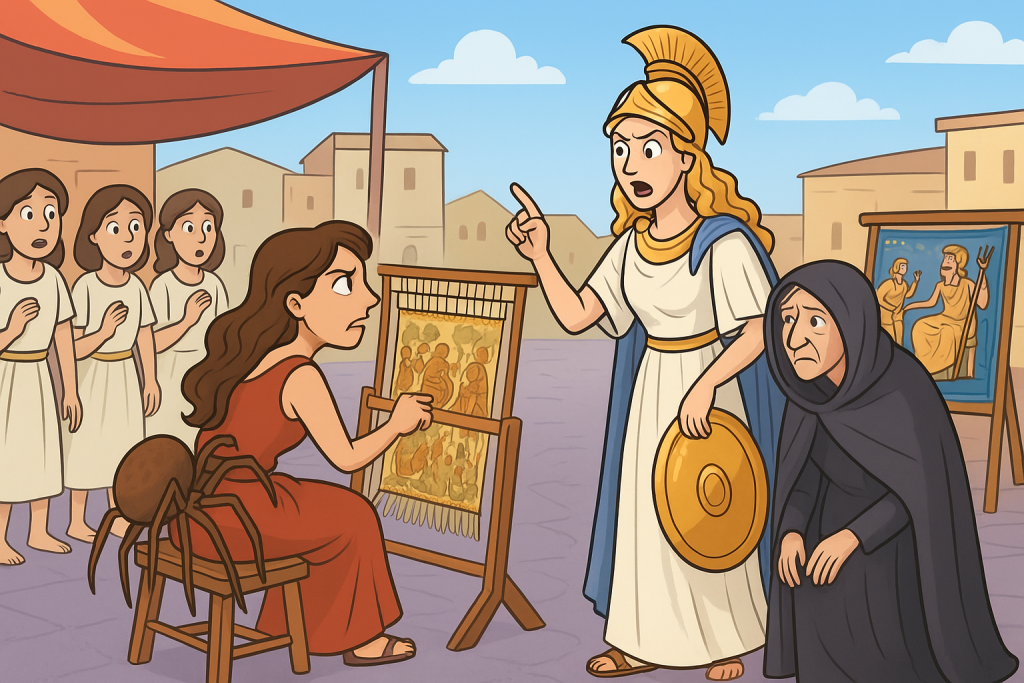
- ARACHNE: Simple, earthy-toned dress (e.g., brown, deep red) to signify her mortal, humble origins. (The actress should have a large spider easily concealed on her back for the final reveal.)
- ATHENA: Elegant white/silver/gold gown, possibly with a blue or olive accent (her colors), a helmet or olive wreath.
- OLD WOMAN: A dark, heavy cloak and hood to completely disguise Athena.
SCRIPT:
ACT I – The Challenge
Setting: A bustling marketplace in Lydia, near Arachne’s home. The left side of the stage holds Arachne’s loom. The right side is a public area where the Chorus gathers.
(Chorus 1, 2, 3, and 4 are gathered near Arachne’s loom, admiring her work. Arachne is actively weaving on the left side of the stage.)
CHORUS 1: (Whispering to Chorus 2) Look at her fingers fly. Is there a magic to her work, or is it merely skill?
CHORUS 2: It is more than mere skill, I tell you. Look at the figures she weaves—they breathe! A stunning tapestry.
CHORUS 3: Arachne is beautiful and talented, yes, but her pride is a heavy cloak she wears. It will smother her.
CHORUS 4: I heard she boasts she weaves better than even Pallas Athena herself!
(Athena enters from the back, hidden by a heavy, hooded, dark robe. She blends in, listening.)
CHORUS 1: Hush! Such words are dangerous. Who gave her such a gift? Surely, it must have been the goddess.
ARACHNE: (Without looking up, dismissing the thought) What nonsense is this? Athena taught me nothing! I learned to weave all by myself, through pure mortal effort. I owe no debt to any god!
CHORUS 2: You must be careful, Arachne. Athena is the Goddess of Arts and Crafts. To dismiss her is… madness.
ARACHNE: (Stands up, holding her head high) Madness? Or truth? There is no one in the world—mortal or immortal—who can weave as beautifully as I can! If the goddess has a problem with my claim, let her come and face me!
(The Chorus gasps and steps back, frightened.)
CHORUS 3: You challenge a goddess?! She is the patron of this very craft!
ARACHNE: A title is not a talent. Let her descend from Olympus. If she dares…
ACT II – The Contest
(Athena, still disguised as an Old Woman, approaches Arachne. Her voice is ancient and brittle.)
ATHENA (as Old Woman): My dear girl, I have lived many years and seen many a rising star fall to ruin. Take an old woman’s advice. Do not ever challenge an Olympian. No mortal can compete against Athena. Take back your words and ask for forgiveness.
(Arachne stands firm, hands on her hips.)
ARACHNE: Your advice is unwanted. I know my own skill. If Athena truly dares to prove me wrong, why does she send an old woman instead of appearing herself? Is she afraid?
(Athena throws back her hood, revealing her regal appearance and tiara/wreath. Her tone is sharp and powerful.)
ATHENA: She is here! We shall see who has the greater skill. Let us compete now!
(The Chorus kneels, terrified, covering their faces or mouths.)
CHORUS 4: The goddess is upon us!
ARACHNE: (A wide, confident, almost insane smile) I have been waiting for this moment! Bring the stools!
(Chorus 1 and 2 quickly place the two chairs in the center. Athena and Arachne sit and begin a stylized, focused action of weaving, moving their arms and bodies as if working furiously. This should last longer than a “few seconds” to build tension—perhaps thirty seconds of focused, dramatic ‘work’ accompanied by rising, rhythmic music.)
CHORUS 1: Look at Athena’s speed! Her threads are silk and moonlight.
CHORUS 2: Look at Arachne’s focus! Her tapestry is already coming to life.
(Athena stands first, holding up her completed tapestry. ) It is a magnificent depiction of the gods’ glory, specifically showing the contest between Athena and Poseidon for Athens.)
CHORUS 3: Just beautiful! A hymn to Olympus!
CHORUS 4: It is a warning, woven in thread—a depiction of insolence punished!
(Arachne laughs—a sharp, scornful sound.)
ARACHNE: (Standing, holding up her own tapestry.) That is your work? A bland lesson in piety? Now, look at a true masterpiece!
(Arachne displays her tapestry. It is breathtakingly beautiful but depicts the secret scandals and shameful deceptions of the Olympian Gods, focusing on Zeus’s many affairs.)
CHORUS 1: (Whispering) It is a work of art… but so bold!
CHORUS 2: It shows the gods not as perfect rulers, but as flawed, powerful beings!
ATHENA: (Her voice shaking with suppressed rage.) You dare! You mock the King of the Gods, my father, Zeus! You slander the immortals for all the world to see!
(Athena throws down her own tapestry. She approaches Arachne and, in a sudden, violent movement, snatches Arachne’s work and tears it to shreds.)
ARACHNE: (Screaming) No! My work!
ATHENA: (Furious, pointing her finger at Arachne) You wished to spin for all eternity? I grant you your wish!
(Athena casts the spell with a powerful, commanding voice.)
ATHENA: You shall spin forever, but never again with thread of silk or wool. You will be a SPIDER!
(Arachne falls to the floor, convulsing, and curls up. The actress should roll to display the pre-attached spider on her back.)
ATHENA: You wanted to create beauty that people would flock to see? Now, you will develop webs that people will always destroy! Go! Weave your fragile, magnificent traps, and let your pride be your eternal curse!
(Athena sweeps off stage. The Chorus remains kneeling, shuddering. Arachne is left alone, a spider on the floor.)
Arachne and the Goddess of Weaving remind us that even the most talented among us must stay humble. Arachne’s pride blinded her to wisdom, turning her extraordinary gift into a lifelong curse. True greatness does not come from boasting, but from honoring our abilities and showing gratitude for them. Whether we weave, paint, sing, or write — what matters most is how we use our talents.
The End
Author: K I D S I N C O, based on a Greek Myth
Moral: Pride can destroy even the most beautiful talents.
Moral Values:
- Humility: Respect the source of your talents and stay modest.
- Respect: Honor those who teach and inspire you.
- Wisdom: Know when to listen and when to stay silent.
- Consequences: Every action — and every word — carries weight.
- Gratitude: Appreciate your gifts instead of boasting about them.
👉 Explore our full collection of free play scripts for kids, perfect for classroom performances.
👉 Explore the epic journey of Theseus And The Labyrinth Of The Minotaur. This myth takes you deep into the heart of Crete, where the savage Minotaur awaits in a twisting, inescapable maze. With the help of the princess Ariadne and a simple thread, Theseus faces the ultimate test of strength, wit, and destiny.
👉 External Resources:
- Arachne – Encyclopedia Britannica
- Athena – Greek Mythology
- Athena – Learn more about Athena’s wisdom, artistry, and connection to weaving
- Greek Myths – Myths and World Stories
This play script, “Arachne and the Goddess of Weaving,” is the property of Kidsinco and may not be republished, copied, or distributed on any other website, blog, forum, or social media platform without written permission from Kidsinco. It is intended for personal and educational use only.
Thank you for visiting Kidsinco Free Play Scripts for Kids!